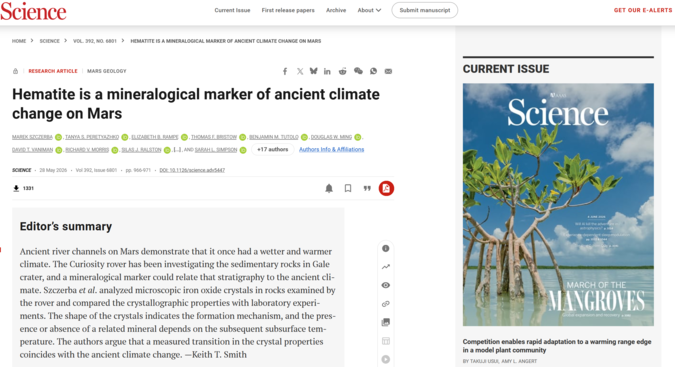
We are proud to announce that Dr hab. Marek Szczerba, Professor at ING PAN—Head of the ING PAN Research Centre in Kraków and a member of the Clay Minerals Research Group at ING PAN—is the joint first author of an article published in the prestigious journal Science.
The publication, entitled “Hematite is a mineralogical marker of ancient climate change on Mars,” presents the results of research into climate changes that occurred on Mars in the past. The scientists analysed mineralogical data from 20 rock samples collected by NASA’s Curiosity rover at different elevations within Gale Crater.
The study demonstrated that the size and structure of hematite crystallites may provide a mineralogical record of the environmental conditions that once prevailed on Mars. The observed differences in hematite crystal size, together with the presence or absence of goethite, made it possible to reconstruct changes in temperature and water availability during successive stages of Gale Crater’s history.
The results indicate that warm groundwater may have persisted in deeper rock layers for approximately 4.7 million years, even as the climate at the Martian surface became increasingly cold and dry. This suggests that potentially habitable environments may have existed beneath the surface of the Red Planet for much longer than previously thought.
The publication contributes to research on the geological and climatic history of Mars and demonstrates how detailed mineral analysis can support the reconstruction of ancient planetary environments.
We warmly congratulate Dr hab. Marek Szczerba, Professor at ING PAN, and the entire research team on this outstanding achievement!
Publication:
M. Szczerba et al., “Hematite is a mineralogical marker of ancient climate change on Mars,” Science, 2026, Vol. 392, No. 6801, pp. 966–971.