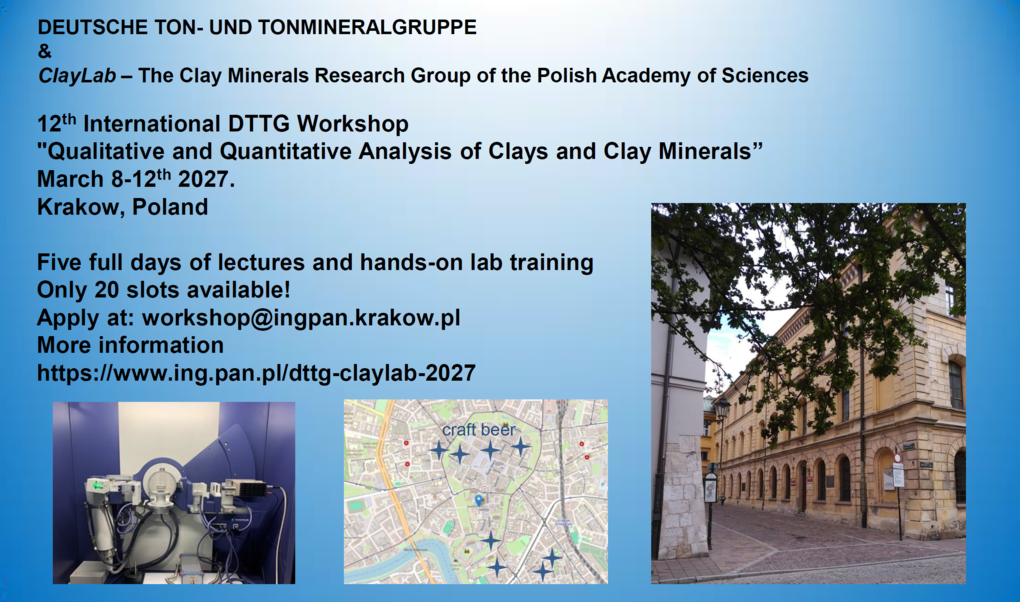

Workshop consists of five days of lectures and hands-on laboratory training on:
Lecturers and laboratory instructors (confirmed so far): Georgios D. Chryssikos (National Hellenic Research Foundation, Athens, Greece), Reiner Dohrmann (BGR, Hannover, Germany), Albert H. Gilg (Technische Universität München, Germany), Georg Grathoff, Laurence Warr (University of Greifswald, Germany), Reinhard Kleeberg (TU Bergakademie, Freiberg, Germany), Michael Plőtze (ETH Zürich, Switzerland), Matthias Schellhorn (Stephan Schmidt Group), Zuzanna Ciesielska, Arkadiusz Derkowski, Mariola Kowalik-Hyla, Artur Kuligiewicz, Karolina Rybka, Marek Szczerba, Adam Zięba, (Polish Academy of Sciences, Krakow, Poland
Who should apply: students and professionals working with clay materials, clay-bearing rocks, and on clay-related topics. Background knowledge on clay mineralogy and analytical methods will be helpful.
How to apply: submit a CV or resume and a short description of clay-related topic(s) you work on to workshop@ingpan.krakow.pl (subject: Clay workshop). For students: please also submit a short description of your thesis and contact information to your supervisor
Application deadline: October 31st, 2026. Acceptance decision will be sent by November 15th, 2026
Venue location: IGSPAS Research Centre in Krakow, Senacka 1, 31-002 Krakow, Poland
in the very heart of the Old Town, between the Market Square and the Wawel Royal Castle, with dozens of hotels, aparthotels, museums, restaurants and bars within 10 min walking distance.
Fee: students (500 EUR), academic professionals (800 EUR) and industry professionals (1400 EUR)
Fee includes: participation in lectures and laboratory training, workshop materials and software, lunches, drinks and snacks, social dinner, all-week travel pass for city transportation
Transportation: