
The Institute of Geological Sciences of the Polish Academy of Sciences invites prospective candidates to explore the current offer of the GEOPLANET Doctoral School.
The website provides information on admission procedures, study conditions, current announcements and available research topics.
The group of asteroids bearing names associated with Poland has expanded to include an object named in honour of Dr Anna Łosiak, a planetary geologist and researcher at the Institute of Geological Sciences of the Polish Academy of Sciences.
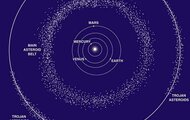
Asteroid (20160) Annalosiak, previously designated 1996 TH42, was discovered on 8 October 1996 at the La Silla Observatory in Chile by Belgian astronomer Eric Walter Elst. It belongs to the main asteroid belt, located between the orbits of Mars and Jupiter.
Dr Anna Łosiak is an assistant professor at the ING PAN Research Centre in Wrocław. Her research interests include the surfaces of planetary bodies and impact craters. She studies the processes involved in the formation of meteorite impact craters on Earth and other bodies in the Solar System.
In July 2026, asteroids were also named in honour of four other Polish researchers involved in the study of small Solar System bodies:
Emil Wilawer, a specialist in the physical properties of asteroids and the analysis of variations in their brightness, after whom asteroid (20322) Emilwilawer was named;
Dr Karolina Dziadura, whose research includes the Yarkovsky effect as well as asteroid density, size, rotation and shape, honoured with asteroid (20446) Karolinadziadura;
Dr Krzysztof Langner, who studies asteroid dynamics and the Didymos–Dimorphos system investigated by the DART and Hera missions, after whom asteroid (20459) Krzysztoflangner was named;
and Monika Kamińska, an astronomer affiliated with Adam Mickiewicz University in Poznań who conducts asteroid observations, commemorated by asteroid (20551) Monikakamińska. (astro.amu.edu.pl)
Among the researchers affiliated with Polish institutions, Dr Milagros Colazo, who comes from Argentina and works at Adam Mickiewicz University in Poznań, was also honoured. Asteroid (20280) Colazo bears her surname. (polskieradio.pl)
Naming an asteroid after Dr Anna Łosiak is a remarkable distinction and a recognition of her achievements and contribution to the development of planetary geology.
We warmly congratulate Dr Anna Łosiak and all the researchers who have received this distinction!
More information:
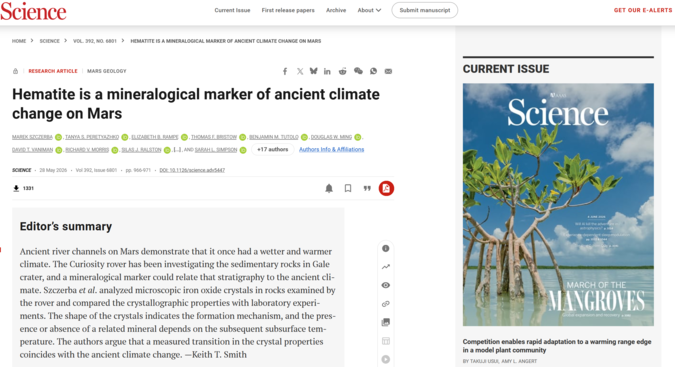
We are proud to announce that Dr hab. Marek Szczerba, Professor at ING PAN—Head of the ING PAN Research Centre in Kraków and a member of the Clay Minerals Research Group at ING PAN—is the joint first author of an article published in the prestigious journal Science.
The publication, entitled “Hematite is a mineralogical marker of ancient climate change on Mars,” presents the results of research into climate changes that occurred on Mars in the past. The scientists analysed mineralogical data from 20 rock samples collected by NASA’s Curiosity rover at different elevations within Gale Crater.
The study demonstrated that the size and structure of hematite crystallites may provide a mineralogical record of the environmental conditions that once prevailed on Mars. The observed differences in hematite crystal size, together with the presence or absence of goethite, made it possible to reconstruct changes in temperature and water availability during successive stages of Gale Crater’s history.
The results indicate that warm groundwater may have persisted in deeper rock layers for approximately 4.7 million years, even as the climate at the Martian surface became increasingly cold and dry. This suggests that potentially habitable environments may have existed beneath the surface of the Red Planet for much longer than previously thought.
The publication contributes to research on the geological and climatic history of Mars and demonstrates how detailed mineral analysis can support the reconstruction of ancient planetary environments.
We warmly congratulate Dr hab. Marek Szczerba, Professor at ING PAN, and the entire research team on this outstanding achievement!
Publication:
M. Szczerba et al., “Hematite is a mineralogical marker of ancient climate change on Mars,” Science, 2026, Vol. 392, No. 6801, pp. 966–971.
We are proud to announce that a publication by our colleague, Stefano Giunti, has been recognized among the most-read articles published in 2024 in Sedimentology — one of the world’s leading journals in the field of sedimentology.
This distinction is especially meaningful as the article represents the first publication related to Dr. Giunti’s doctoral research and has already attracted considerable attention from the international scientific community.
This achievement highlights the importance of the research being conducted and demonstrates the vital role that early-career scientists and international collaboration play in advancing modern science.
We warmly congratulate Dr. Giunti on this success and wish him many more inspiring scientific achievements in the future!
As part of the celebrations marking the 70th anniversary of the Institute of Geological Sciences of the Polish Academy of Sciences (ING PAN), held on 12 May 2026 at the headquarters of the Polish Academy of Arts and Sciences in Kraków, the special guest of the event was Prof. Carsten Münker from the University of Cologne — a world-renowned expert in isotope geochemistry and the evolution of the Earth and the Solar System.
Prof. Münker delivered a lecture entitled “From the early solar system to Earth’s interior: new clues from new isotope tools” within the “GeoPlanet” seminar series. The presentation focused on the latest research concerning the formation of the Earth, the origin of the Moon, and the evolution of Earth’s interior, investigated using state-of-the-art isotope analytical methods. We invite readers to explore the presentation materials.
In his lecture, Prof. Münker presented a modern perspective on the earliest stages of Solar System history and the processes that led to the formation of the proto-Earth and its first magma reservoirs. Particular attention was devoted to short-lived isotope systems, such as the 182Hf–182W system, which make it possible to reconstruct events occurring within the first tens of millions of years after the birth of the Solar System.
The presented research results addressed, among others:
The lecture demonstrated how enormous advances in analytical techniques now allow scientists to investigate processes that occurred more than 4.5 billion years ago with unprecedented precision. Particular interest was drawn to results suggesting that the Earth–Moon system and the first proto-crust of the Earth may have formed within the first 60 million years of Solar System history.
Prof. Carsten Münker is Professor of Geochemistry and Petrology at the Institute of Geology and Mineralogy, University of Cologne (Universität zu Köln), Germany. He leads a modern isotope analysis laboratory specializing in radiogenic and stable isotope research applied to planetary geochemistry, cosmochemistry, and studies of Earth’s interior evolution.
His scientific achievements include pioneering studies on the origin of the material forming the Earth and terrestrial planets, the differentiation processes of Earth’s interior, the history of the Earth’s mantle, and the chronology of the Moon’s formation. He is the author of numerous publications in leading scientific journals such as Nature, Nature Geoscience, Science, and PNAS, and his work ranks among the most highly cited research in isotope geochemistry and planetary sciences.